

🫖 Once More With Civility
On Spectacle, Silence, and the Rules Meant to Break Us

“It is not enough to be quietly non-racist. We must be vocally anti-racist.”
— Angela Davis
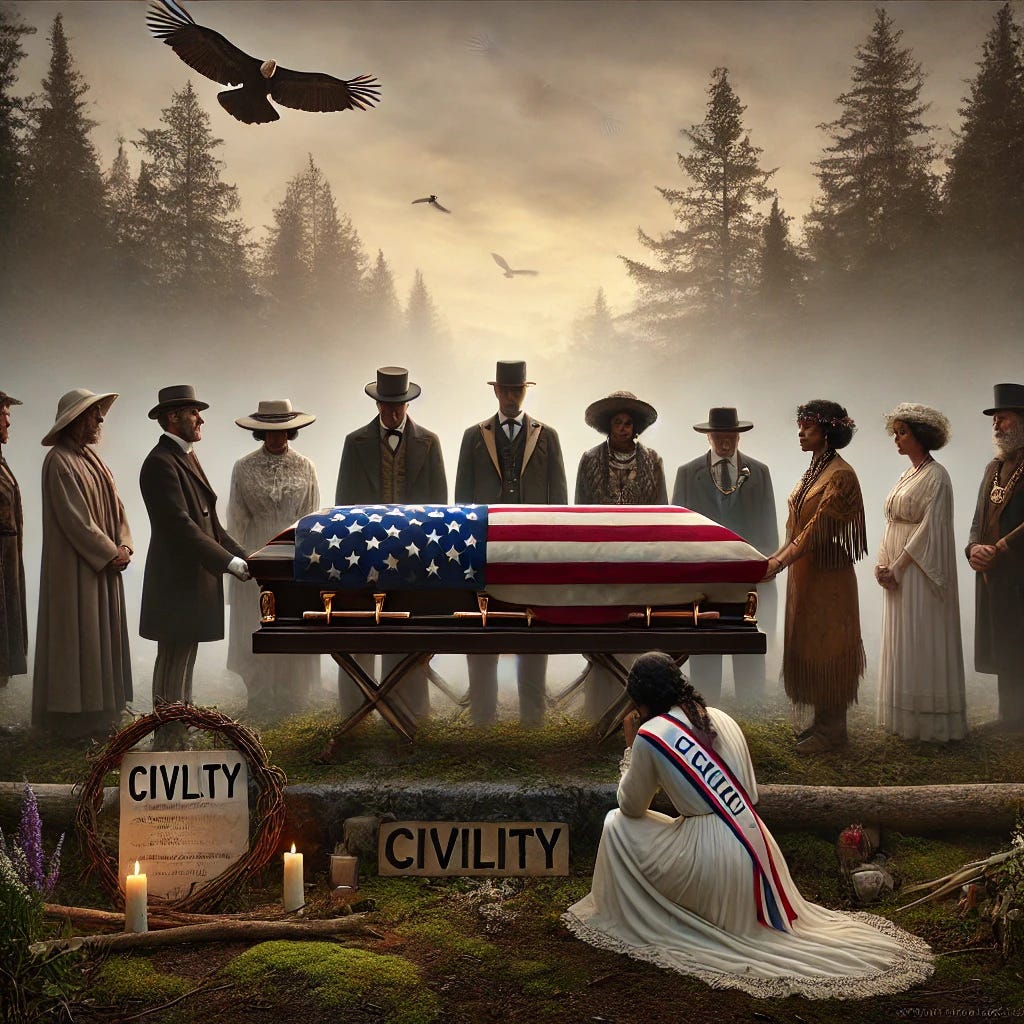
🎩 Welcome, Friends of the Feather and the Flame
To the old souls and the newly stirred, to every reader who finds themselves holding their breath in this sweltering season of American contradiction—welcome home to the table.
We gather once more in the long, strange heat of a republic in reflection. While the cicadas hum and the headlines burn, the people of these United States are again being asked to choose between comfort and courage, noise and nuance, spectacle and civility.
Ah yes, civility. That old chestnut. That favorite teacup pulled out when power feels threatened and truth runs too hot. I have been thinking on civility and what it looks like in our modern world ever since reading Wanted: Storytellers to Meet this Moment by the talented philosophical soul Justina Chen.
Last week, in Once Upon a Republic, I talked about the importance of storytelling about our democracy and our history, while Friday we did some storytelling about community and the impact that persistent community can have in A Hearth in a Storm
But let’s not be fooled. In this moment, when so many of our so-called statesmen preach about "restoring civility," we must ask: Whose version? And at what cost? Yes we need a return to civility—but not in the way so many seem to think.
🎩 Of Gloves, Gowns, and the Gilded Lie
Civility has never truly been about kindness. It has been about containment.
The word shares roots with civilization, that ever-shifting line used by empires to mark who is welcome in polite company, and who must be tamed, hushed, or removed. It is the genteel cousin of conquest—softer in tone, just as sharp in outcome.
HBO’s The Gilded Age offers more than costume drama; it’s a mirror. Within its tapestries and parlor rooms, civility becomes a velvet noose. To enter society, one must master endless rules: when to visit, how to speak, what to wear, who to acknowledge. But these rules were never neutral.
When a Black opera singer is invited to perform, she is met not with applause, but uproar—not because of her voice, but because her presence breaches the false decorum that keeps certain people “in their place.” A new-money woman with ambition dares to dream in marble and steel, and is told her taste is vulgar. A widow speaks plainly and is mocked for lacking poise. The message, then and now, is clear: civility is a cudgel.
And in 2025, it is still wielded to police, punish, and preserve power.
Just ask Congresswoman Nancy Mace, who teases a run for Governor of South Carolina even as she shrugs off the grotesque nature of our immigration system. She joked that she watches border patrol footage on YouTube for entertainment—turning human suffering into spectacle.
Nancy might think she is bringing new perspective but in reality it is the same tired argument dressed up to be more “civil” . It originates in darker times here in the American South: the “picnic lynchings” of the Jim Crow South.
Families gathered with children in tow, smiling for cameras beside the broken bodies of Black men and women. Their deaths, their courage, their resistance—reduced to postcards, passed around with pride.
You can look back even earlier and see yet more example in Europe’s public executions, where rebels and paupers were hanged for the pleasure of the crowd and by the pleasure of the monarch, their defiance snuffed out on a stage dressed as justice.
Civility did not stop these spectacles. It justified them. It wrapped them in law and lace and told the masses that this was order, that this was good behavior rewarded and bad behavior punished.
Sound familiar?
🔥 Let the Teacups Rattle
And so we return to our present, where too many would rather sip lukewarm niceties than name the fire under the table. Where “civility” is used to scold protestors, silence dissent, and demand that we make our pleas for survival a little more palatable to the powerful.
Civility without justice is performance. And civility that tolerates cruelty is complicity.
We must learn to tell the difference between noise and voice, between decorum and dignity.
🦴 What Civility Was Meant to Be
Long before it became a euphemism for silence, civility had teeth. And heart.
True civility is not about proper forks and hushed tones. It is about the sacred obligation to treat sentient life—regardless of race, creed, gender, or class—as worthy of dignity. Not just legally, but spiritually.
Anthropologist Margaret Mead once said that the first sign of civilization was not a tool or a weapon, but a healed femur. In the animal kingdom, a broken leg is a death sentence. But in early human communities, a bone that had time to knit back together meant someone had stopped. Cared. Protected. Fed another until they could stand again.
This is the real root of civility: mutual protection. Care. The stubborn insistence that every life deserves tending. When that principle is violated—when we permit suffering for amusement, allow cruelty to parade as politics, or let silence be mistaken for peace—we break civility’s bones anew.
⚔️ When Civility Was Defended with Blood
Lest we forget: societies have always understood that civility mattered because its breach had consequences.
In the not-so-distant past, a grave insult could lead to pistols at dawn. The duel, though archaic, was built around the premise that honor—civility’s twin—must be defended, even to the death. In the American South, such rituals lingered well into the mid-1800s, not just as performance but as a deadly belief: that an offense unaddressed poisoned the community. Many speak of “Southern Hospitality” as the sugar coating in which things are presented in the south: they fail to see that those rules were iron clad and bound in blood. Be kind, be civil, or be willing to pay with your life.
Where the law was absent or uneven, blood feuds took root. Families like the Hatfields and McCoys were torn apart over slights that spiraled into generational war. In the Scottish Highlands, entire clans were extinguished for breaches of custom, insult, or injury.
These were brutal, yes—but they reveal a deep truth: when the civil contract is broken, societies fracture.
Today, we no longer meet insult with swords, but we still bear the consequences of a civility unraveled. We see it in fractured communities, online mobbing, legislative gridlock, and public cruelty dressed up as entertainment. We see it in leaders who provoke chaos not out of necessity, but spectacle. And we see it most clearly in the numbness that follows repeated breaches—until we forget what real civility ever looked like.
🕊️ Time to Write a New Code
So let us not long for a return to "civility" as it has been falsely sold: a sterile peace where the powerful are never questioned. Let us not pine for the tepid, tidy order that asks the wounded to whisper.
Instead, let us reclaim civility as what it always should have been: a radical act of mutual regard. A commitment not to appearances, but to healing. Not to etiquette, but to empathy—to the real work of being human together.
True civility is not the absence of conflict. It is the presence of conscience.
“The world is before you and you need not take it or leave it as it was when you came in.”
— James Baldwin
That is the charge before us—not to restore civility as it was, but to remake it as it should have been. A code not written in table manners and double standards, but in the sacred work of care.
Because when Nancy Mace tells us she watches videos of human suffering for entertainment—and then dares tease that she will let us know about the Governors run, the executive of our states civil functioning—we see the truth laid bare. Civility is not what is being defended. It is what is being desecrated.
To demand civility while dehumanizing others is to break the very code one pretends to uphold. And to ask that no consequences follow—that no one speak too loudly, protest too boldly, or dare to name the cruelty—is the most indecent ask of all.
Civility is not owed to spectacle. It is owed to humanity.
And when those in power forget that, it becomes the duty of the people to remind them—with unshakable care, with radical conscience, and yes, sometimes with a voice that trembles the teacups.
Until our Next Bold Move,
~Lady LiberTea ✨🫖
📚 Beyond the Tea Table
Dear friends,
If today’s tea has left a rattle in your chest or a crack in your heart, know you are not alone. There is still so much good to be done. There are bones still mending. There is care to give, and codes worth writing together.
Below are a few stepping stones should you wish to walk further down this path—from study to story to service:
📚 Anthropology & Compassion
Explore the legacy of Margaret Mead, who taught us that true civilization begins with the act of healing. Her book Coming of Age in Samoa and essays on early human cooperation offer timeless insights into empathy as a civic act.
⚔️ History of Honor & Feuds
To better understand the consequences of broken social contracts, visit the Smithsonian’s “Duel!” article or explore the Hatfield-McCoy Feud Timeline—cautionary tales of bloodshed born from breaches of civility.
🕊️ Restorative Justice in Practice
Support modern efforts to repair harm rather than amplify spectacle. Organizations like RJOY (Restorative Justice for Oakland Youth) or TransformHarm offer powerful alternatives rooted in healing, not punishment.
🌱 A Personal Reflection
Join the conversation here by reflecting on:
Who have you helped heal?
Who helped you?
What does a healed femur look like in your life, your community, your country?
These small repairs are where true civility begins again.
With grace, always—
~L.L. ✨🫖
Excellent point about when civility is appropriate and not.
The framers of the U.S. Constitution gave us a system of government featuring a separation of powers, checks and balances, and federalism. This arrangement works best when competing factions gather to engage in civil discourse to formulate policy. Civil discourse is characterized by discussion, debate, and eventual compromise. However, if the need to "compromise" is used to justify the denial of rights and justice delayed, I'd prefer to pass on it in favor of agitation. Likewise, while civil discourse is necessary for productive policy debate, if one side is determined to name call, belittle, and demonize the opponent over every difference in opinion, the exercise of civil discourse becomes a lost cause. While one can make the case that the Orange Menace (not very civil of me) is not solely responsible for the loss of civility (the trend predates Trump's entrance to the national political stage), he has brought it to the lowest point in my lifetime. Every day Trump's rhetoric hits a new low. Civil discourse which is needed to meet people where they are and move them to a more enlightened point of view seems lost in 21st century America.
I feel redundant in saying 'excellent work,' but you always seem to produce excellent work, so here we are. This one is important. I hope it gets the traction it should here.