

Created Equal: The Pickle Paradox
How America’s Taste for Disgust Soured the Promise of Liberty

🌿 Greetings, My Dear Defenders
Whether this is your first time joining for tea or you are an old friend matters not — I am simply glad you have found your way. Here, you have found shelter from the storm: a warm and wild haven where everyone has a place to belong and comrades to laugh with.
All here in the tea garden are cherished not for what they produce, but for their presence alone. We enjoy a cup of courage steeped with care by a loving hand and gather our strength to face the battles ahead, while honoring those we have already won — together.
In this fight we wage against the would-be tyrants clawing at our democracy’s foundations, there are many roles. All are needed, and all are vital to the cause — yet no single person could possibly fill them all. Some may shoulder two or three, but never every one.
Here at our tea table, amongst friends and kin buoyed by our cups of courage, we persevere in our shared role: to face difficult and universal truths. To seek answers to our future by delving into the vastness of our past and the whole experience of human existence.
While others are fighting the good fight in every corner of the nation — myself among them — here at the tea table we focus on teaching, educating, and equipping you with the necessary tools to do battle with this foe, and to win.
Let us begin.
📚 The Inspiration
At one point, now decades ago, I read a book entitled Created Equal: Why Gay Rights Matter in America. Written and published in the early 1990s by Michael Nava and Robert Dawidoff, it lays out a blistering, world-shattering argument showing not only that LGBTQ+ citizens were stripped of their inherent rights, but that our Founding Fathers — and indeed the very core of our democracy — depended entirely on extending them.
“We hold these truths to be self-evident, that all men are created equal…” — Declaration of Independence, 1776
The past few weeks, while lost in literary worlds and seeking inspiration for a Firebird Friday post, I re-read this book and felt the world come to a screeching standstill.
Assumptions the writers made regarding the place America stood just thirty years ago broke my heart. In some ways, they could not imagine the world we live in today — with the right to marry the partner of your choosing, the pair to your soul. They did not think to see that victory within their lifetime, perhaps not even for a century.
What a swell of pride at the outcome of their work, and of bittersweet wonder at my own luck to be born in this time. Yet for every moment of pride, there was one of fear — even revulsion. Rights and privileges that the writers erroneously considered societally acknowledged and safe regarding women’s rights, the rights of immigrants, African Americans, and others have eroded and crumbled into something almost unrecognizable.
As a keeper of this sacred lore, I know this well from living the everyday reality of our times — and yet to see it so starkly in black and white print, a mirror showing exactly how far we have fallen, left me reeling.
I spent some time mourning, some time reflecting, and then I decided:
It was time to do something.
So today, we begin breaking down the argument for LGBTQ+ rights at its core just as these courageous authors did. I do not seek to take the spotlight away from other groups in peril. Rather, I believe that by focusing on this argument — laying it open at its foundation — you will see, as I do, that it is not about one group having special privileges. It is about ensuring that all of us — every single one of us, regardless of race, religion, sex, creed, sexual orientation, or gender expression — are entitled to life, liberty, and the pursuit of happiness, endowed by our Creator with sovereignty over personal choice.
“Injustice anywhere is a threat to justice everywhere.” — Dr. Martin Luther King Jr., 1963
Please note: while Nava and Dawidoff wrote before transgender inclusion was common in the public lexicon, we include all members of minority sexual orientations and gender identities under this banner. While sexuality and gender expression are entirely separate, they are equally condemned in the eyes of many today — and the same hollow arguments are used to target both.
But before we even begin to unpack constitutional arguments or moral philosophies, we must face a quieter, uglier truth: the “ick” that shapes policy long before any law is written. Disgust, more than doctrine, has been the quiet architect of bigotry.
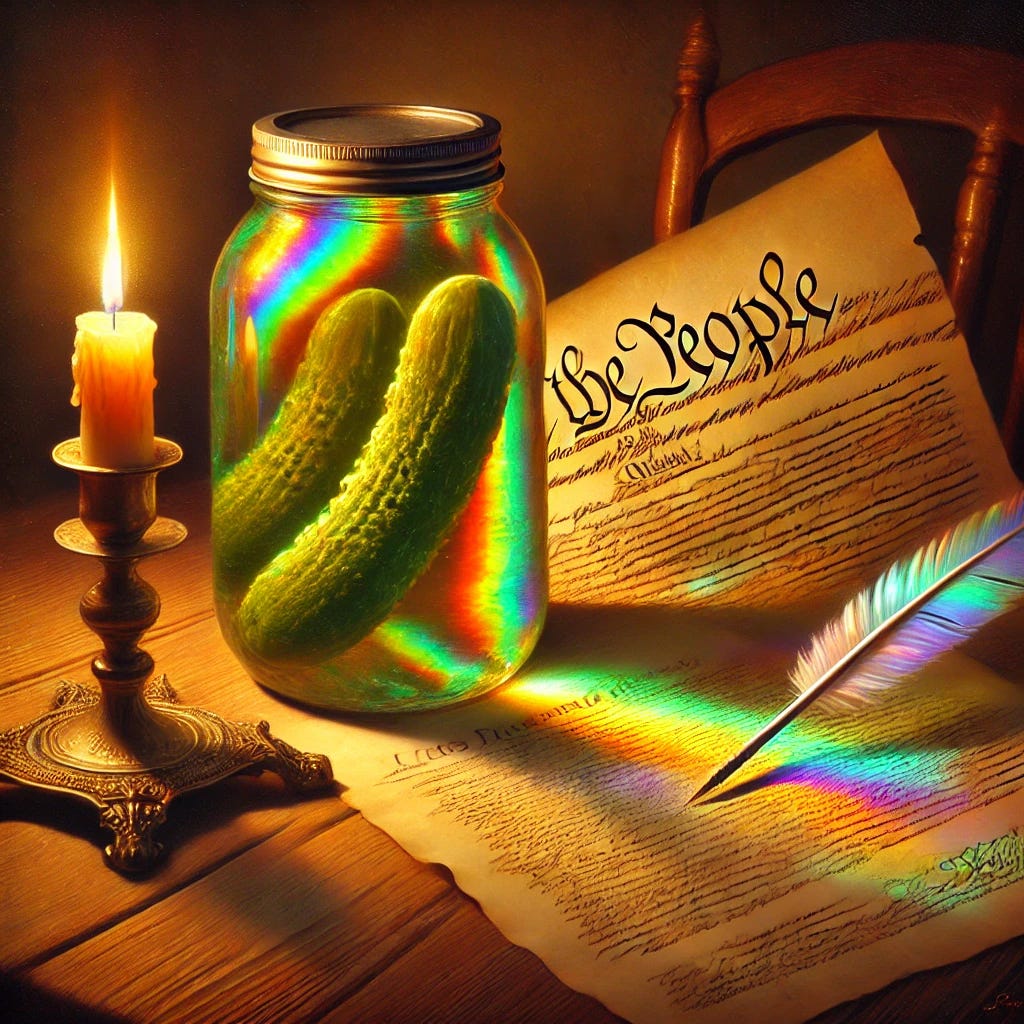
For this reason, friends, today we tackle what Nava and Dawidoff referred to as the ick problem — or as I affectionately call it, The Pickle Paradox. Sit back, relax — perhaps plug your nose if needed — and let us discuss.
Before we dive into the heart of this, the first essay in the series, a word of warning: this Lady does not suffer fools. While commentary will remain open on all of the pieces of this series, as per usual, I will be watching. Failure to respect the other tea time guests or maintain the safety and sanctity of our tea time gathering will result in permanent exile from our tea garden — not to mention the embarrassing natural consequence of facing a wordsmith and lore keeper while having a middling grasp of the English language and even less of human history. May the odds be ever in your favor — I don’t like your chances.
🥒 The Pickle Paradox
I detest pickles. I always have. I hate the taste. The smell of an open pickle jar alone will make me gag, and I get the eye twitches when someone starts chomping on one. Don’t let me hear you say “pick it off” either — those disgusting things poison the food with their juices seeping in.
Now while this is my personal opinion on pickles, I recognize that there are lots of people who like them. In fact, I imagine many of you like pickles. Good for you! Here in this country, under our Constitution, you are entitled to enjoy pickles to your heart’s content. We are all entitled to make this choice for ourselves.
Now let’s say all the pickle lovers got together and decided to form a religion dedicated to the Great Pickle. (Humor me. Perhaps they saw one too many VeggieTales.) Whatever their reason, the doctrine is simple: preach the good word and work of the Great Pickle — that those who do not like pickles are destined for damnation, unworthy of love, and a plague on society.
This too would be their right under the codes of our society as written. While I would certainly take issue with both their core beliefs and their teaching — the same laws which protect my right to not like pickles protect theirs to be as vocal as they like in their love of the pickle.
In recognizing their freedom and right to personal choice, I enshrine my own.
But now let us imagine that roughly ninety percent of society are pickle lovers. They eat them at every meal. They bathe in pickle-scented cologne. They dress in shades of green to glorify the Big Pickle in the Sky and attract other pickle lovers to mate over a jar of gherkins.
Those pickle lovers might begin to see people who didn’t eat pickles as suspect — morally questionable. They can’t help but imagine them eating cucumbers dipped in ranch and feel a twist of disgust.
And that revulsion — that “ick” — that’s the pickle paradox. What begins as a shiver of disgust in the gut becomes doctrine, law, and cruelty — all in the name of “virtue.”
🧃 Childish Disgust
If you think this sounds a little childish, friends, that’s because it is. While we expect children to make decisions for their health and well-being based on disgust — just as a child who refuses to eat anything green — we expect this stage to be short-lived.
When assuming the burdens of adulthood, one also assumes the responsibility and broader worldview that what we may find “gross” or “yucky” has no bearing whatsoever on what is right or wrong. Arguments from disgust belong more firmly in the realm of the schoolyard than in political or educational parlance — yet they are always the first leveled and the last addressed.
“Prejudice, not being founded on reason, cannot be removed by argument.” — Samuel Johnson, 1756
When a person announces they are a member of the LGBTQ+ community, they become immediately sexualized — and as a result, may lose the connection of family, friends, community, even faith. The institution most meant to offer sanctuary instead recoils, the taste of vomit rising.
Now don’t get me wrong: I understand the disgust. What they are imagining in their heads is sexual intercourse — between men, between women, or perhaps they are simply wondering what someone might have below the waistline. For someone with an opposite worldview, that mental image might generate disgust — for them.
But no one asked you to crawl into bed with them. In fact, to be frank, we would prefer the pickle lovers stay out of our bedrooms entirely. You are welcome to your disgust — just keep it on your side of the door.
Republics, after all, are only as grown as their citizens. A democracy governed by disgust is no more than a playground with ballots.
🧠 The Psychology of Disgust
Disgust is, in fact, an evolutionary advantage — the mind’s early warning system against harm. It keeps us from putting the unknown mushroom growing in cow dung into our mouths. Things that are new and different once meant danger, and for hunter-gatherers subsisting on berries and mushrooms, it was advantageous to be grossed out by what might kill you.
But what once protected us from spoiled food now poisons our civic diet.
Even our forefathers — for all their flaws — understood that disgust and personal prejudice make ill advisors when fabricating systems of government meant to last.
“It is error alone which needs the support of government. Truth can stand by itself.” — Thomas Jefferson, 1786
While not immune to their own failings, they built a framework where the individual, not the government, is the highest decision-maker in matters moral, material, political, and yes, even sexual. The Framers, for all their contradictions, understood that disgust is a poor architect of liberty. That is why they placed conscience and choice not in the government’s hands, but in the individual’s.
⚖️ From Disgust to Doctrine
Here lies the true danger. When private revulsion becomes public policy, democracy begins to rot from the inside out. We are all entitled to disgust by things we choose not to participate in — hence why you are also entitled to the choice of participation or the lack thereof. Rarely does it end there.
What starts as “ick” at a dinner table turns into sodomy laws. It hardens into “Don’t Say Gay.” It metastasizes into book bans and bans on healthcare — each one dressed up as moral protection while serving only to codify disgust.
Lawrence v. Texas (2003) overturned sodomy laws in the U.S., affirming that “liberty presumes an autonomy of self that includes freedom of thought, belief, expression, and certain intimate conduct.”
Nava and Dawidoff warned that gay rights are the canary in the constitutional coal mine — that when the government begins deciding whose humanity feels palatable, it has already declared that humanity negotiable.
And that, my friends, is the death of liberty.
Before we can fix the law, we must fix the lens through which we see our neighbors. Before we can call ourselves created equal, we must unlearn the reflex of revulsion that keeps us apart.
This legislated disgust isn’t just fodder for Nancy Mace’s commentary about who gets to use the restroom — it is a real, visceral problem that has taken real lives.
It’s baked into the “gay panic” defenses that once excused murder, into custody rulings like Bottoms v. Bottoms (Virginia, 1993), where a mother lost her child solely for loving another woman. It’s etched into the faces of countless people who would rather take their own lives than live in a world that sees them, at best, as entertainment — and at worst, as a perversion of nature.
That is the cost of allowing disgust to become doctrine — life. Life is the cost.
Well, friends, I don’t know about you, but in the words of one of my favorite songs:
I. Have. Had. Enough.
🕊️ Where Do We Go From Here?
Every sexual and gender-expressing minority reading these words can recount a story at the drop of a hat about someone who lost everything because of society’s fascination and disgust with who they loved or what body they had. In fact, so strong was that disgust it became a monster — and as a community, we built closets to hide in and grew beards to hide our faces.
Just like a caterpillar must first go through the chrysalis stage before dazzling with color and graceful flight, so too has every LGBTQ+ person had to learn to love themselves despite the evil and immoral acts society equates with their existence.
We have had to see that what society may find disgusting is not made inherently evil by that disgust — that we are not disgusting people simply because others fail to understand the beauty and wonder of our natural experience.
Scientifically we refer to this process of continually coming out and self-acceptance as addressing internalized homophobia or gender dysphoria. Yet at its heart, it’s much simpler: it is the process of stripping away society’s definitions of disgust and vulgarity about what it means to be part of this community and recognizing that we are still inherently us — no more disgusting or unnatural than any other talking ape.
“Love takes off the masks that we fear we cannot live without and know we cannot live within.” — James Baldwin
We are as worthy of love and respect on the day we come out as on the day we were born — endowed by our Creator with those rights, no matter who might find our personal habits disgusting.
With this, my friends, we draw this tea time — and the first of the Created Equal series — to a close. But do not despair. Next week, we return with the next installment.
While civil disgust belongs in a schoolyard, not as the basis for making sound decisions, our Founders were equally careful to protect against the use of religious doctrine as law.
While our contemporary Christian nationalist adversaries have lost the plot and conflated the Founders’ concept of personal religion with a civic imperative for theocracy — this Lore Keeper is not impressed.
Join us next week as we move from the childish antics of disgust as doctrine to the furor and intractability of Christian nationalism. We will crack apart the tired Biblical texts used to pound shame into this community and explore how “divine law” has been wielded as a weapon — even as our Constitution enshrines freedom from such coercion.
Until our Next Bold Move,
~Lady LiberTea ✨🫖
🌈 Postscript: From Disgust to Dignity
If disgust can be taught, so too can dignity.
Let’s start there. Share this piece with someone who’s been told their rights are negotiable. Donate to an organization that fights to make sure they aren’t — like the Human Rights Campaign, the National Center for Lesbian Rights, or the Transgender Law Center.
And, when the next moral panic bubbles up in your town hall or on your timeline, ask one question:
Is this about virtue — or just another pickle paradox?
A German Perspective on Dignity and Duty of Care
Dear Lady Liberty, I recognize the deep truth in your words concerning the initial, reflexive nature of disgust and its subsequent, dangerous transformation into public policy. You have beautifully articulated the process by which a private shiver becomes a public structure, trading true dignity for mere comfort.
However, from a German perspective, which places a fundamentally different emphasis on the concept of dignity and its expression in the state, your analysis points directly to a constitutional tension inherent in the US system: the nearly exclusive focus on individual liberty and individual dignity.
The Dignity Divide: Relational vs. Individual
In Germany, human dignity (**Menschenwürde**) is enshrined in Article 1 of the Basic Law (**Grundgesetz**) as absolute, inviolable, and the supreme guiding principle of the state. This dignity is inherently relational (**Beziehungswürde**).
• Individual Dignity (US emphasis): Often interpreted through a libertarian lens, focusing on negative rights—freedom from state interference, absolute autonomy, and a sphere of self-determination unburdened by societal obligation. The duty is primarily on the individual to assert their rights.
• Relational Dignity (German emphasis): Recognizes that human worth is interdependent and realized within a community. It demands positive obligations from the state and from citizens toward each other. The state's duty is not just to protect the individual from others, but also to actively guarantee the conditions for a dignified existence for everyone.
The Missing 'Duty of Care' (**Fürsorgepflicht**)
The problem you describe—where reaction becomes policy—is structurally enabled by the American focus on liberty without an equal emphasis on a duty of care (**Fürsorgepflicht**).
The deep-seated issues we are witnessing—from stark social inequality to fractured public health response—may be baked into the Constitution precisely because the framework prioritizes individual negative freedom above a foundational social duty to ensure a baseline dignity for all citizens.
Where the US system might see a "private shiver"—that initial reaction of disgust or discomfort—the libertarian impulse allows that shiver to be used as justification for non-intervention, for exclusion, or for deregulation, arguing that duty only lies with the self.
Conversely, a system grounded in relational dignity views that initial reaction not as a policy template, but as a signal that the social contract is failing, demanding state intervention to re-establish the conditions for mutual respect and shared well-being.
Your call for "teaching regulation, curiosity, presence" is the civic practice needed, but in the German view, the state itself is constitutionally mandated to establish the framework for this active, caring community.
Without that legal mandate of duty of care, the individual liberty you cherish risks devolving into a system that only protects the comfort of the privileged, inevitably fostering the very hierarchies you lament.
Oh my goodness 🥰🙌💕
Absolutely Brilliant!
So much YES! ❤️🇨🇦❤️